
What is La Mercè?
La Mercè is Barcelona's festa major: the city's own big festival, held every September in honour of the Mare de Déu de la Mercè, Our Lady of Mercy, one of Barcelona's patron saints. It has been an official city celebration since 1871, and over a century and a half it has grown into a sprawling, five-day programme that takes over squares, streets and parks right across the city.
Calling it "a festival" undersells it. La Mercè is really dozens of festivals stacked into one long weekend: human towers and devil fire-runs from the Catalan popular-culture tradition; the free BAM music programme that fills the city with concerts; the MAC street-arts festival; light projections onto historic façades; a fireworks finale synchronised to music; air shows, parades and family events. Most of it is free, most of it is outdoors, and all of it is open to anyone who turns up.
New to Barcelona? If you only learn one date in the city's calendar, make it La Mercè. It is the single best window into Catalan culture and the warmest moment to feel that you actually live here, not just visit.
La Mercè 2027: Dates & the Holiday
The heart of La Mercè is always 24 September, the feast day itself, which is a public holiday specific to the city of Barcelona. In 2027 it falls on a Friday, so the festival lines up with a natural long weekend. Events always spread across several days around the feast; recent editions have run four or five days. The Ajuntament confirms the exact 2027 dates and programme in late summer, and this page will carry them as soon as they are out.
Dates
Around Friday 24 September 2027
The central feast day is Friday 24 September. Full dates confirmed in late summer.
Public holiday
24 September
A local holiday in Barcelona; many shops and offices close.
Where
Across the whole city
Sant Jaume, the Gothic Quarter, the seafront, parks and squares.
Cost
Mostly free
Castells, correfoc, BAM concerts and the piromusical are all free.
Because 24 September falls on a Friday in 2027, the holiday hands the city a three-day weekend, so expect the festival crowds to peak from Friday through Sunday. The full official programme (published by the Ajuntament de Barcelona in the weeks before the festival) lists every event with its exact time and place. It is worth a proper read, because La Mercè runs hundreds of separate events and no two editions are identical. Two reliable anchors each year: the popular-culture displays (castells, correfoc, gegants) cluster around the central days, and the piromusical fireworks close the festival on the final evening.
Why It Matters If You Live in Barcelona
La Mercè is not a tourist attraction that residents tolerate: it is the city's own party, and that distinction matters. Here is why it is worth building your September around it.
- It is the city at its most itself. La Mercè is where Barcelona shows you Catalan tradition without translation or ticketing: castells in the medieval square, devils with fireworks down a closed central avenue, giant figures dancing through the Gothic Quarter. You will not understand it all at first, and that is fine.
- It is largely free. An entire long weekend of concerts, fireworks, street arts and spectacle that costs nothing to attend is rare in a major city. La Mercè is funded as a public festival, for the public.
- The holiday changes the city's rhythm. With 24 September a local holiday, museums open free, transport runs differently, and the working week bends around it. Knowing this in advance saves you a wasted trip to a closed office.
- It is a way in. Festivals are where a new city stops feeling foreign. Show up to a castells display or a BAM concert and you are doing exactly what your neighbours are doing, the simplest form of belonging there is.
The Highlights to Catch
La Mercè is too big to "do" completely. Better to pick a handful of signature events and build a relaxed plan around them. These are the ones worth prioritising.
Castellers: the human towers
The castells are human towers, built level upon level by teams called colles, often eight or nine storeys high and crowned by a small child who climbs to the top. The big castells diada usually takes place in Plaça de Sant Jaume, the square between the city hall and the Catalan government palace. It is precise, athletic and quietly emotional, so arrive early, because the square fills fast.
Correfoc: the fire run
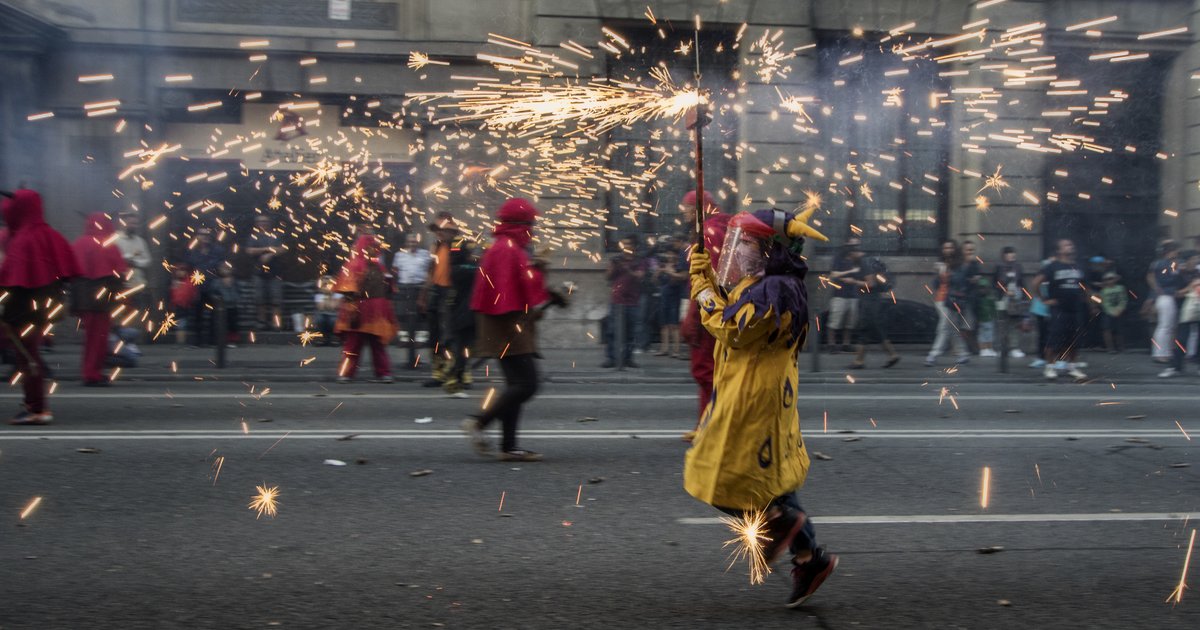
The correfoc is La Mercè at full intensity: colles de diables, troupes dressed as devils, dance through the streets, historically along Via Laietana though the route moves from year to year, spinning fireworks on pitchforks while drums pound, and the crowd surges and weaves through the sparks. It is exhilarating and genuinely fierce. To be in it, wear long sleeves, long trousers, closed shoes and a hood, all in natural fibres, never synthetics. To watch it, find a spot to the side. There is a separate, gentler correfoc infantil for children.
Gegants i capgrossos
The gegants (towering figures carried and danced by a person inside) parade through the city with the big-headed capgrossos and bands. The processions wind through the Gothic Quarter and are one of the most photogenic and family-friendly parts of the festival.
BAM and the music programme
BAM (Barcelona Acció Musical) is the festival's free music strand, with stages set up in squares and parks across the city, leaning toward independent and emerging artists. Alongside it, the broader Música Mercè programme spreads concerts of every genre throughout the days, from classical in churches to bands in the parks.
Light shows and street arts
After dark, historic façades around the city become canvases for projection-mapped light shows, often with a dedicated route you can walk. The MAC (Mercè Arts de Carrer) strand fills streets and parks with circus, theatre and acrobatics. Both are free and easy to drop into.
Living in Barcelona? Don't miss what's on
Barcelona Expat Daily: a 5-minute English digest of the day's local news, plus the events worth your time. Free, no credit card.
The Piromusical Finale
If there is one moment that defines La Mercè, it is the piromusical: the grand fireworks finale, choreographed to music, that closes the festival on the final evening and draws a huge, city-wide crowd.
For most of its history it has been staged at the base of Montjuïc near Plaça d'Espanya, with the pyrotechnics timed to the jets of the Font Màgica. That changed in 2026. Building works at the Fira de Montjuïc pushed the display down to the sea, and it was fired from Platja de la Nova Icària instead. The upside was space: the seafront gives a far longer viewing line than Avinguda de Maria Cristina ever did. Check the 2027 programme for where the display lands this time; the Ajuntament announces the location with the rest of the programme in late summer.
It is spectacular, and it is busy. Tens of thousands of people converge on the same place, so the experience is as much about the logistics as the fireworks. Arrive well before the start to claim a viewing spot and expect packed metro stations afterwards. The reliable trick in any year is to stand back from the dead centre: when the display is on the water, as in 2026, the far ends of the beach and the neighbouring Bogatell stretch stay noticeably thinner while the view holds up.
Crowd-safety reminder: the piromusical and the correfoc both draw dense crowds. Agree a meeting point with anyone you come with in case phones lose signal, keep valuables secure and zipped away, and have a clear plan for getting home before you arrive. Pickpockets work the biggest crowds.
Practical Info
Getting around
Use public transport (the metro, buses and trams) and leave the car at home. Streets in the centre, around Sant Jaume and Via Laietana, are closed or heavily restricted during events, and parking is near-impossible. On 24 September, the public holiday, transport runs on a holiday timetable, so check times before late-night journeys. The metro is busiest immediately after the piromusical.
Read the programme
La Mercè genuinely cannot be improvised well: it is too large and too spread out. The Ajuntament publishes a full programme and an app each year with every event, time and location. Skim it in advance, mark three or four things you actually want to see, and let the rest happen around them.
Museums on the holiday
Many of Barcelona's museums open with free admission on 24 September as part of La Mercè. If there is a museum you have been meaning to visit, the holiday is a good, free moment to do it, though expect queues at the most popular ones.
Eat, drink and the weather
Late September in Barcelona is usually warm and pleasant, but evenings can cool down and a shower is possible, so a light layer is worth carrying. Restaurants in the centre fill up around festival events, so book ahead for dinner, and stay hydrated if you are out in the daytime crowds.
Insider Tips
- Pick a theme, not a checklist. Trying to see everything leaves you exhausted and underwhelmed. Choose one castells display, one concert, the piromusical, and enjoy them properly.
- Go early for the castells. Plaça de Sant Jaume fills long before the towers start. Arriving early gets you a real view instead of the back of someone's head.
- Decide your correfoc role in advance. Either dress properly and join the run, or pick a side-street vantage point. The worst spot is unprepared in the middle of it.
- Watch the piromusical from the edges. Wherever it is staged that year, the view from the back or the far end is still superb, with far fewer people and a much easier exit.
- Explore beyond the centre. BAM stages and events run in parks and squares across the city, including quieter neighbourhoods. Some of the best, most local moments are away from the Gothic Quarter crush.
- Treat the holiday as a city day. With 24 September off and the city in festival mode, it is a fine day to combine a free museum, a wander and an evening event: a proper local day out.
FAQ
When is La Mercè 2027 in Barcelona?
La Mercè 2027 centres on Friday 24 September, the feast of Our Lady of Mercy and a public holiday in Barcelona. Events always spread across several days around it and across the whole city, so expect the long weekend of 24 to 26 September to be the core. The Ajuntament confirms the exact dates in late summer.
Is 24 September a public holiday in Barcelona?
Yes. 24 September is a local public holiday specific to the city of Barcelona for La Mercè. Most shops, schools and offices close or run reduced hours, public transport runs on a holiday timetable, and many museums offer free admission that day.
Is La Mercè free?
Overwhelmingly yes. The castells, the correfoc, the gegants parade, the piromusical, the BAM concerts, the street arts and the light shows are all free and open to everyone. A few special events are ticketed, but you can have a full La Mercè without paying for entry.
What is the piromusical at La Mercè?
The piromusical is the festival's grand finale: a large fireworks display choreographed to music, on the final evening. It has traditionally been staged at the base of Montjuïc beside the Font Màgica, but the location can change: in 2026 it moved to Platja de la Nova Icària, because of the building works at the Fira de Montjuïc. It draws enormous crowds, so arrive early for a good spot.
What is the correfoc at La Mercè?
The correfoc, or fire run, is a procession of devil troupes who dance through the streets brandishing spinning fireworks while drums play, with the crowd weaving through the sparks. To take part, wear long sleeves, long trousers and closed shoes in natural fibres; otherwise watch from a safe distance. There is a separate, gentler children's correfoc.
Where do the main La Mercè events take place?
La Mercè is spread across the city: Plaça de Sant Jaume and the Gothic Quarter for castells and popular culture, a closed central avenue for the correfoc (Passeig de Gràcia in 2026), the seafront or the Montjuïc area for the piromusical depending on the year (Platja de la Nova Icària in 2026), and parks and squares for the concert programmes. The official programme maps everything.
Is La Mercè a good festival for newcomers to Barcelona?
It is one of the best. La Mercè is largely free, mostly outdoors, and showcases the whole of Catalan popular culture in one long weekend. It is an easy, low-commitment way to feel part of the city: no tickets needed, no Catalan required.
Where can I keep up with what's happening in Barcelona?
Our free daily newsletter sends a short, English-language summary of Barcelona's news and events every day, so you always know what is going on in the city, festival week or not. Join below.
Daily Barcelona news in English. Free.
Join 1,800+ expats across Spain. Every day: a 5-minute summary of Barcelona news, events and what's worth your time, in clear English.